Why Being “Easy to Understand” Is More Powerful Than Being Impressive
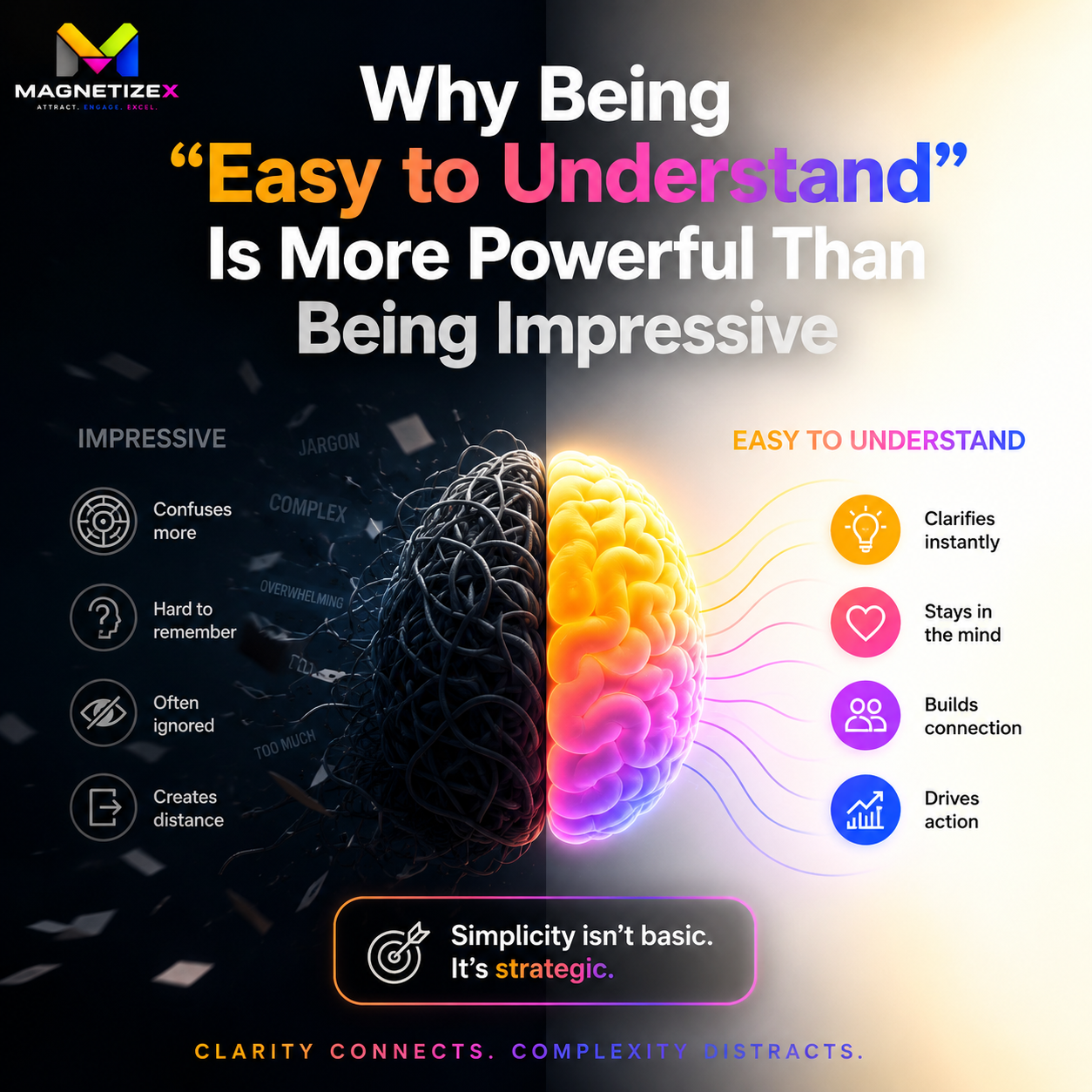
There is a particular kind of person people remember immediately.
Not necessarily the smartest person in the room. Not the person with the longest bio, the most impressive credentials, or the most complicated vocabulary.
The person they remember is the one they could explain to someone else.
“She helps founders turn complicated ideas into clear content.”
“He’s the designer who makes technical products feel human.”
“She teaches senior professionals how to become visible without becoming performative.”
That is the beginning of a Magnetic Personal Brand.
Not impressiveness. Recognition.
What is a Magnetic Personal Brand?
A Magnetic Personal Brand is a clear, consistent reputation that helps the right people quickly understand who you help, what you do, how you think, and why they should remember you. It is built through repeated signals, useful ideas, recognizable language, and a point of view people can easily describe to someone else. Personal brand clarity is the foundation everything else rests on.
The word “magnetic” can make personal branding sound like a performance. It is usually the opposite. The strongest personal brands reduce confusion.
A person visits your website, reads one post, or hears your name in a conversation. Within a few minutes, they should have a rough answer to four questions:
What do you do?
Who is it for?
What do you believe?
What changes because of your work?
If they need a long explanation, your brand may be impressive, but it is not yet memorable.
Someone looking at your name online should be able to understand your work and why it matters quickly. That basic clarity is also one of the recurring principles in current personal-brand guidance.
Why does being easy to understand matter more than being impressive?
Being easy to understand matters because people cannot recommend what they cannot describe. Clarity gives your audience a usable mental category for you. Once people know where you fit, they can remember you, refer you, invite you into relevant conversations, and recognize when your work solves a problem they have.
This sounds obvious until you look at how many personal brands are written.
“I help visionary leaders unlock transformational growth through strategic alignment.”
That sentence might be accurate. It might even be true. But it gives the reader nowhere to stand.
Compare it with:
“I help small service businesses explain what they do so more people trust them.”
The second version is less impressive. It is also easier to repeat.
That is the important trade.
Many people try to make their personal brand sound bigger than their actual work. They add abstract nouns, broader audiences, and grander promises. They think sophistication creates authority.
Often, it creates distance.
A reader should not have to admire your sentence before understanding it.
What is the difference between being clear and being simplistic?
Clarity is not the same as simplification. Clarity preserves the important idea and removes the unnecessary effort required to understand it. A clear personal brand can contain nuance, expertise, and ambition. It simply gives those qualities a recognizable shape before asking the audience to explore them.
This is where people sometimes resist.
“I don’t want to sound basic.”
Fair. Nobody wants to spend years learning a difficult subject only to describe it like a children’s worksheet.
But clear language is not childish language. It is generous language.
A surgeon can explain a procedure plainly without knowing less. A strategist can name the problem without making it sound smaller. A writer can have a distinctive point of view without hiding it behind phrases like “leveraging multidimensional ecosystems.”
The test is simple:
Could the right person repeat what you do after one conversation?
Not word for word. They do not need to remember your tagline. They need to remember the shape of your value.
The Recognition Test: can people explain you when you are not there?
The Recognition Test is a practical way to evaluate a personal brand. Ask five people who know your work to complete this sentence: “You should talk to this person if you need help with…” Compare their answers. The distance between those answers shows how clear or scattered your brand currently is.
I like this test because it removes you from the room.
Most brand exercises ask what you want to be known for. That matters, but it is only half the picture. Your personal brand lives in the gap between your intention and other people’s recall.
If five people describe you differently, you may have several strengths but no central signal.
That does not mean you need to choose only one interest forever. It means your audience needs a doorway.
You can be a writer, strategist, coach, speaker, researcher, and builder. But if every introduction begins with the entire list, people may remember none of it.
Choose the first door.
The rest of the house can come later.
How do you make a personal brand easier to understand?
Make a personal brand easier to understand by narrowing the audience, naming the problem, using concrete language, repeating a small number of ideas, and connecting your expertise to a visible outcome. To build a clear and compelling personal brand, your profile, website, content, and offers should make the same basic promise in different forms.
Try completing this sentence:
I help [specific person] move from [recognizable problem] to [desirable outcome] through [your method or perspective].
For example:
I help independent consultants turn scattered expertise into a focused content strategy.
It is not a complete brand. It is a starting point.
Then look for the language you naturally repeat in conversations. What do people ask you to explain? What problems do you notice before others do? What advice do you keep giving, even when nobody has paid you for it yet?
Those repeated patterns are often more useful than a brainstorming session about your “unique genius.”
Your brand is usually hiding in the things you find obvious.
That is inconvenient, because obvious things rarely feel impressive to the person who knows them well.
Why does consistency make a personal brand magnetic?
Consistency makes a personal brand magnetic because repeated ideas become easier to recognize and trust. Consistency does not mean publishing the same sentence everywhere. It means your audience keeps encountering the same underlying point of view, promise, tone, and type of usefulness across different moments.
You might say it differently in a podcast, an email, a sales call, and a social post. That is healthy. A person is not a slogan.
But the underlying message should rhyme.
If your website says you help founders simplify their message, while your content is mostly about productivity, and your sales calls focus on visual identity, people have to reconcile the contradiction themselves.
Most will not.
They will simply move on.
This is why a personal brand often feels “inconsistent” before it feels invisible. The problem is not always lack of content. Sometimes there are too many disconnected signals competing for attention.
A little repetition can feel boring to you because you are close to it.
Your audience is not.
Is an impressive personal brand still useful?
An impressive personal brand is useful when its expertise is attached to a clear promise. Credentials, awards, experience, and sophisticated ideas can strengthen a brand, but they rarely create the first moment of recognition. People need to understand the value before they have a reason to appreciate the depth behind it.
Imagine two profiles.
The first begins with seven qualifications and a paragraph about industry leadership.
The second begins with one sentence that explains a problem the reader has been struggling to name.
The first may be more impressive.
The second is more likely to be read.
This does not mean you should hide your experience. It means your experience should support the message instead of becoming the message.
Authority is easier to receive when people know what it is for.
There is probably something here about how the same principle applies to portfolios, pitch decks, and even dating profiles. I have not worked that out fully. The pattern is still there, though: people connect faster when they do not have to decode the other person first.
How do you balance clarity with personality?
Balance clarity with personality by making the core message simple and letting your voice, examples, opinions, and stories make it distinct. The promise should be easy to understand. The way you express it should feel recognizably yours.
Clear does not mean bland.
Two people can both say, “I help founders communicate better,” and create completely different brands.
One might be warm, patient, and analytical. Another might be blunt, funny, and allergic to business jargon. One may teach through frameworks. Another may teach through stories from failed launches and awkward sales calls.
The subject can be similar. The interpretation is not.
Personality enters through details:
The words you refuse to use.
The problems you keep challenging.
The examples you choose.
The kind of people you defend.
The kind of advice you make fun of.
The small distinctions you notice.
Your message gives people the category.
Your personality gives them a reason to stay.
Three signs your personal brand is trying too hard to impress
A personal brand may be trying too hard to impress when it uses broad promises, hides the actual work behind jargon, or changes its message to match every new trend. These patterns create distance because the audience spends more time interpreting the brand than understanding its value.
Watch for these signs:
- Your description could belong to anyoneIf your bio could be copied onto the profile of a consultant, coach, agency, or creator in almost any industry, it is probably too broad.
- You use outcomes nobody can picture“Transformational growth” is hard to imagine. “A clearer offer that people understand in one conversation” is easier.
- You sound different in every roomAdaptation is normal. Reinvention is expensive. If your message changes completely for every audience, people may struggle to build a stable memory of you.
The fix is not to become more polished.
It is to become more specific.
What should you do next to build a Magnetic Personal Brand?
To build a Magnetic Personal Brand, choose one audience, one recurring problem, one meaningful outcome, and three ideas you want to be associated with. Use those elements consistently across your profile, content, conversations, and offers. Then ask real people what they think you do without giving them the answer first.
You do not need a perfect niche statement.
You need a message that can survive contact with another human being.
Write the simplest version first. Say it out loud. Notice where you start apologizing for it or adding qualifications. Remove the qualifications and see what remains.
Then publish enough for people to encounter the same signal more than once.
The goal is not for everyone to understand you.
The goal is for the right people to think, “I know exactly who to send this to.”
That is when a personal brand starts to pull people closer. Not because it is louder. Because it is legible.
And once people can understand you, they finally have a chance to remember you.
Ready to become the obvious choice?
Get your Positioning Audit and turn your expertise into inbound gravity.
Get Your Positioning Audit →