The Signature Tension That Makes Someone Intellectually Magnetic
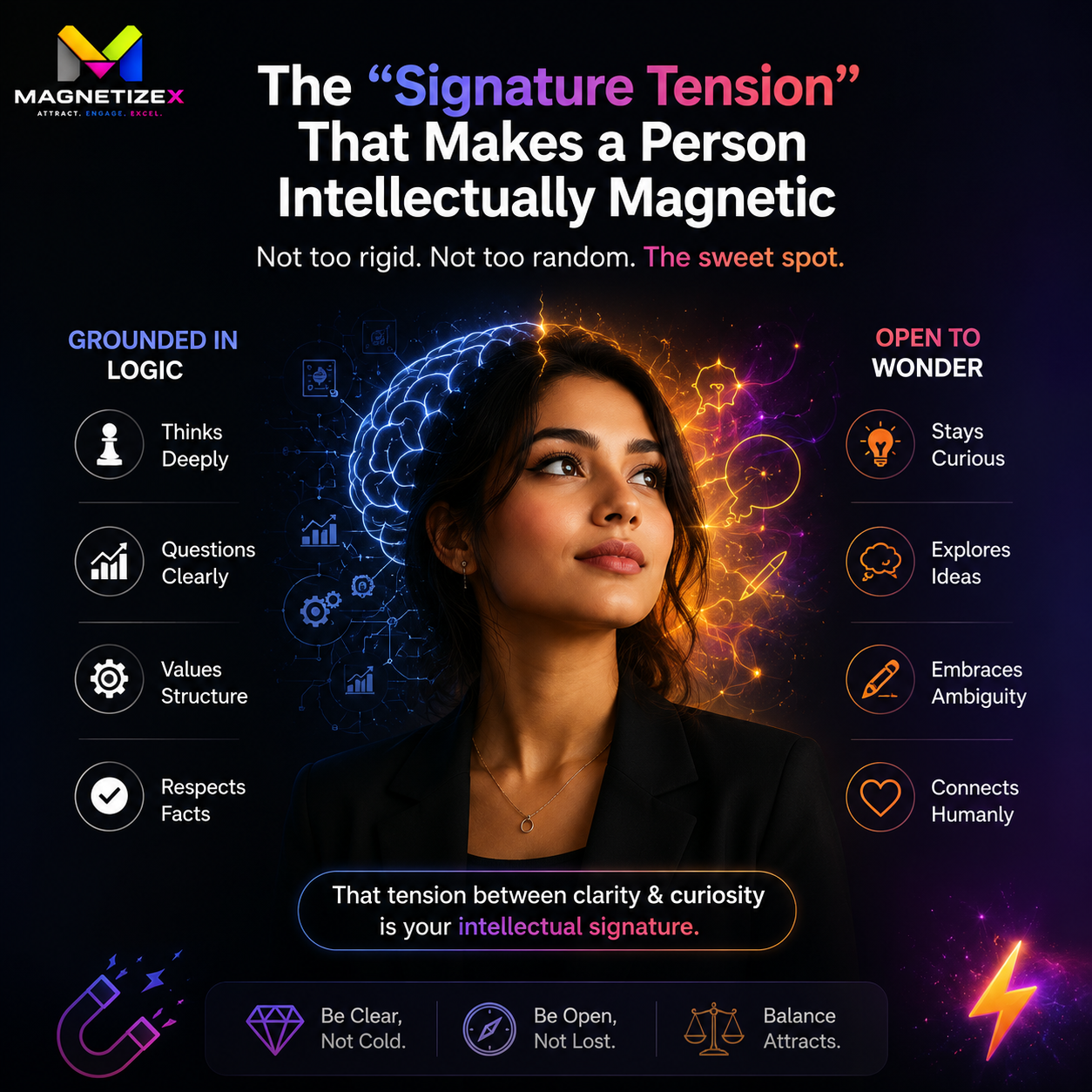
Some people are easy to admire.
They are articulate, informed, accomplished. They know how to make a good point and support it with three more points, just in case.
Then there are people you keep thinking about after the conversation ends.
You remember the strange combination in them.
They were deeply serious about their work but made fun of their own industry. They were confident without sounding finished. They had strong opinions, but you could still feel them listening. They made a complicated idea feel simple, then complicated it again in a way that made you want to stay.
That combination is what I call signature tension.
It is the productive contradiction at the center of someone’s personality, thinking, or work. It is the pull between two qualities that appear to conflict but, together, create depth.
The researcher who is rigorous but playful.
The leader who is ambitious but deeply protective of her private life.
The designer who loves restraint but cannot stop noticing absurd details.
The teacher who makes difficult ideas accessible without making them smaller.
That is where intellectual magnetism usually lives.
What is signature tension?
Signature tension is the meaningful contradiction between two qualities a person consistently holds at the same time. It makes their ideas more memorable because it creates movement, curiosity, and surprise. A person with signature tension is easier to recognize than someone who presents a perfectly polished, one-dimensional identity.
The word “tension” can sound negative. It suggests conflict, discomfort, something that needs resolving.
That is not quite what I mean.
Signature tension is closer to a held note in music. There is a slight pressure in it. You want to hear where it goes.
A person who is only “smart” is easy to categorize. A person who is smart and tender, rigorous and irreverent, private and unusually generous with ideas is harder to reduce.
That difficulty is part of the appeal.
You do not feel confused by them. You feel that there is more to discover.
Why does contradiction make someone intellectually magnetic?
Contradiction makes someone intellectually magnetic because it prevents the mind from completing its first impression too quickly. When two believable qualities coexist, people keep paying attention to understand how they fit together. The result is curiosity, not confusion.
Think about the people whose work you return to.
Often, they are not the people with the most information. They are the people whose way of seeing contains a friction you cannot immediately flatten.
They might believe in discipline but hate hustle culture.
They might care about data but distrust dashboards.
They might teach personal growth while openly admitting that some parts of life should remain unresolved.
The interesting thing is not the contradiction by itself. Anyone can be contradictory. The interesting thing is that both sides are real.
A person who performs a contradiction feels theatrical.
A person who has lived one feels specific.
There is a difference.
What makes a tension a signature tension?
A tension becomes a signature tension when it is authentic, repeated, useful, and visible in a person’s choices. It should appear across their ideas, language, behavior, or creative work rather than existing as a clever description written in a bio.
You cannot invent one by pairing random adjectives.
“Bold yet compassionate” is not a signature tension. It is a nice-sounding personality card.
Try these instead:
Precise, but never precious.
Ambitious, but suspicious of status.
Emotionally perceptive, but intellectually unsentimental.
Drawn to simplicity, but unable to stop exploring complexity.
Serious about quality, but allergic to seriousness as a performance.
Independent in thought, but generous in collaboration.
The test is whether the tension changes what the person actually does.
If someone claims to be “deeply practical but highly imaginative,” can you see both qualities in their work? Do their solutions have imagination in them? Do their ideas eventually become useful?
If not, it is positioning language. Not identity.
The Two-Force Test: how do you find your own tension?
The Two-Force Test helps you identify signature tension by looking for two qualities that repeatedly pull your work in different directions. Start with what people praise, then look for the quality that complicates it. That second force is often where your distinctive perspective begins.
Try finishing these sentences:
People come to me because I am unusually ______. But I get frustrated when that quality is taken too far.
I care deeply about ______. At the same time, I distrust ______.
I am drawn to ______. Yet I keep returning to ______.
My work looks like ______. But underneath it is really about ______.
The last sentence usually takes longer.
That is fine. The useful answer may not arrive as a neat phrase. It might appear as an irritation.
You may discover that you love strategy but dislike the way strategic language makes human problems sound clean. You may realize that you want visibility but do not want to become constantly available. You may care about excellence while resenting the personality type excellence is expected to produce.
Stay with the irritation for a while.
It is often more revealing than your strengths.
Is intellectual magnetism the same as being intelligent?
Intellectual magnetism is not the same as intelligence. Intelligence can help someone understand, analyze, and explain ideas. Intellectual magnetism comes from how a person combines intelligence with curiosity, humility, emotional range, and a distinct way of interpreting the world.
A person can know a great deal and still be forgettable.
They can speak in complete paragraphs that never create any pressure in the listener’s mind. Everything is correct. Nothing is alive.
The intellectually magnetic person usually leaves room around their ideas. They make a claim, but they do not make the conversation feel closed.
They might say:
“I believe this is true, although I am still trying to understand what it breaks.”
That sentence has energy because it contains conviction and openness at the same time.
Research on intellectual traits often separates curiosity, openness to ideas, motivation, and intellectual engagement rather than treating “intellect” as one simple quality. This framework on intellect and intellectual achievement points toward the same broader idea: a compelling mind is rarely just a storage system for facts.
It is a way of relating to questions.
Why do polished personal brands often feel flat?
Polished personal brands often feel flat when they remove the contradictions that would make the person recognizable. The brand becomes consistent in tone but empty in tension. It communicates competence, but not a distinct mind.
This is the part people get wrong about consistency.
Consistency does not require sanding yourself down until every edge has the same shape. It requires repeating the underlying pattern.
A person can be warm in one post and sharply critical in another. The consistency may be that they always make complexity more humane.
Someone else may sound calm in every format, but their ideas repeatedly challenge conventional career advice.
The surface changes. The tension stays.
A polished brand says, “Here is the version of me that makes sense.”
A magnetic body of work says, “Here is the question I cannot stop returning to.”
That is a much more interesting invitation.
How can signature tension improve your writing?
Signature tension improves writing by giving your ideas a point of friction. Instead of producing general advice, you can explore the conflict between two things you genuinely believe. That conflict creates stronger hooks, more specific arguments, and language people are more likely to remember.
Compare:
Good leaders should be empathetic and decisive.
With:
The best leaders I know are deeply empathetic, but they do not use empathy as a reason to delay a decision forever.
The second sentence has somewhere to go.
It creates a question: How do empathy and decisiveness coexist? What happens when they do not? Where does care end and avoidance begin?
That is the job of tension. It gives the reader a reason to continue.
You can build an article, talk, or personal brand around the tension between:
Freedom and structure.
Visibility and privacy.
Speed and care.
Expertise and uncertainty.
Beauty and usefulness.
Belonging and independence.
Growth and enoughness.
You do not need to resolve the tension in the first paragraph. In fact, you probably should not.
Let the reader feel it before you explain it.
Real tension vs manufactured controversy
Real tension comes from holding two honest commitments at once. Manufactured controversy comes from exaggerating a position mainly to attract attention. Real tension deepens a person’s thinking. Manufactured controversy eventually collapses into a repeatable performance.
This is why “hot takes” are such a poor substitute for a point of view.
A hot take wants a reaction.
A real tension wants examination.
Someone who genuinely values both ambition and peace may write about the cost of becoming successful in a way that no longer resembles the life they wanted. Someone manufacturing controversy may simply declare that ambition is toxic because it performs well online.
The first person is working something out.
The second person is working an audience.
You can usually feel the difference. One makes you think about your own life. The other makes you think about whether you agree.
Agreement is a much smaller form of attention.
How do you express signature tension without sounding confusing?
Express signature tension by naming the two forces plainly, showing how they appear in real life, and explaining the principle that connects them. The goal is not to make your identity mysterious. The goal is to make your perspective more dimensional and recognizable.
A useful structure is:
- Name the two forces“I care about visibility, but I do not believe everyone needs to be constantly visible.”
- Show the conflict“That makes me skeptical of content advice built around posting every day.”
- State the deeper belief“I think the point of visibility is to make the right work easier to find, not to make yourself impossible to escape.”
That last sentence is where a perspective begins to sound like yours.
You are not trying to appear complicated.
You are trying to be honest about the complication.
There is probably a version of this for friendships too, the people who are both direct and deeply kind, or funny and strangely good at sitting in silence. I am leaving that there because it feels connected, even if it is not useful for the article.
How do you build a personal brand around signature tension?
Build a personal brand around signature tension by repeating the same underlying contradiction across your message, content, offers, and decisions. Choose a tension that is specific enough to guide your work and broad enough to generate many ideas over time.
For example:
I help experts become visible without turning themselves into performers.
That is stronger than “I help people with personal branding” because it contains a problem, a belief, and a point of view.
It tells people what you are for.
It also tells them what you are against.
That second part matters more than most branding advice admits.
Your strongest ideas may come from the thing you refuse to separate. You want authority and humanity. Precision and warmth. Commercial success and a life that still feels like your own.
Do not rush to choose one side.
The combination may be the work.
FAQ: Signature Tension and Intellectual Magnetism
- What is an example of signature tension?An example of signature tension is being highly ambitious while refusing to treat busyness as proof of importance. Another example is being deeply analytical while communicating with warmth and emotional awareness. The tension becomes distinctive when it appears repeatedly in a person’s ideas, choices, language, and work.
- Can signature tension be developed?Signature tension can be developed through observation, although it cannot be convincingly faked. Pay attention to the contradictions you repeatedly defend, the advice you resist, and the qualities people associate with you. Over time, those patterns can become a clearer point of view and a more recognizable body of work.
- Is signature tension useful for personal branding?Signature tension is useful for personal branding because it gives people a memorable reason to distinguish you from others with similar skills. It helps you move beyond generic traits such as “strategic,” “creative,” or “empathetic.” The tension gives those traits context and makes your perspective easier to recognize.
- Does being intellectually magnetic mean being mysterious?Being intellectually magnetic does not require being mysterious. Mystery with no substance is simply confusion. Intellectual magnetism comes from clarity combined with depth, curiosity, contradiction, and a point of view that remains open enough for people to keep thinking after the conversation ends.
The point is not to become more interesting
You probably do not need to become more interesting.
You may need to stop presenting yourself as if you are only one thing.
The careful thinker who also has strong taste. The ambitious person who wants a quiet life. The teacher who is still confused by the subject they teach. The leader who wants influence but does not want their entire personality converted into content.
That combination is not a branding problem.
It is the material.
A signature tension gives people something to recognize, but it also gives you somewhere to keep thinking from. And that may be the real source of the magnetism.
Not that you have solved the contradiction.
That you are still alive inside it.
Ready to become the obvious choice?
Get your Positioning Audit and turn your expertise into inbound gravity.
Get Your Positioning Audit →